

Despite having the opportunity to defend his calculations, as yet, Bažant has remained silent.
Errors Revealed in Bažant’s Calculations Further Bury the Official Story as ASCE and NIST Continue to Stonewall Calls for a New WTC Investigation
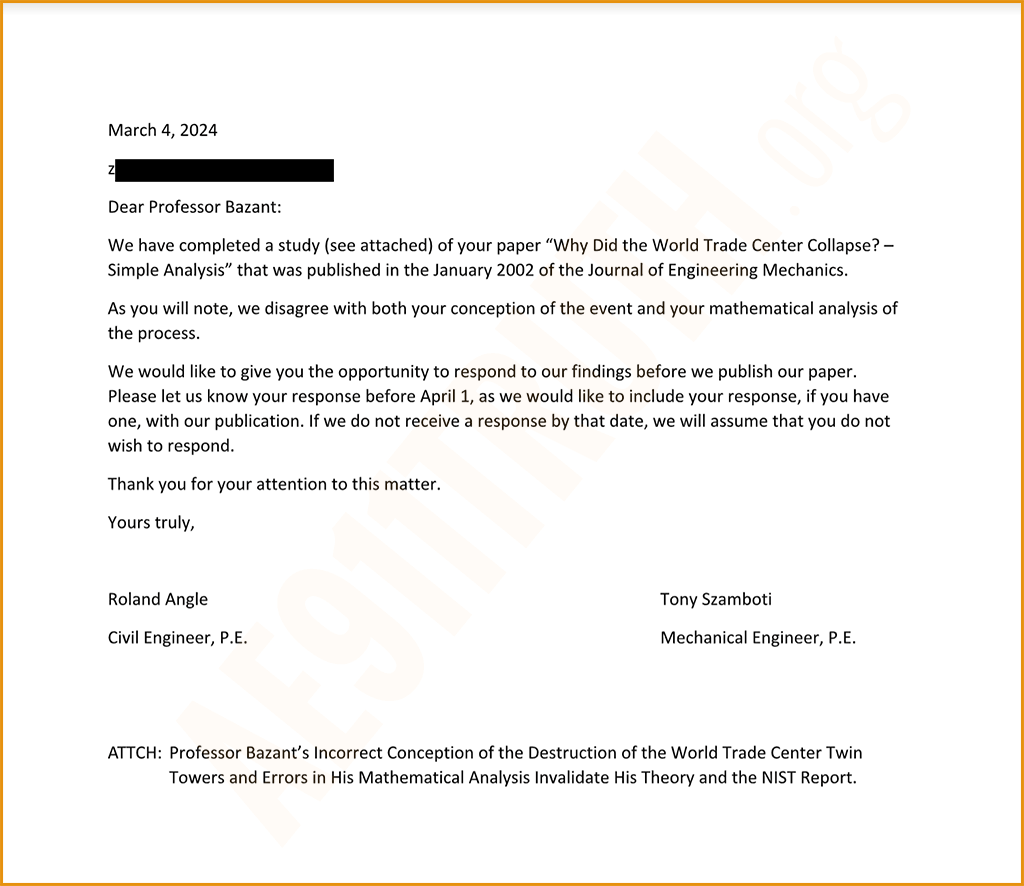
PROFESSOR BAŽANT’S INCORRECT CONCEPT OF THE DESTRUCTION OF THE WTC TWIN TOWERS ON 9/11 AND ERRORS IN HIS MATHEMATICAL ANALYSIS INVALIDATE HIS THEORY AND THE NIST REPORT
- The planes crashed into the towers severing some of the steel columns and damaging others in the zone of the aircraft impacts.
- The debris from the planes tore the fireproofing off some of the steel floor trusses in the impact zones.
- Fires caused by the explosion of the jet fuel erupted in the impact zones.
- The floor trusses were weakened by the fires and sagged, pulling in the perimeter columns.
- After burning for the next hour or so, the heat from the fires weakened the structure and the weight of the building above the fire and impact damaged zone overcame the ability of the damaged zone to bear the weight of the upper part of the building. The upper part of the building then fell down through the damaged zone and collided with the lower part of the building.
- The force of the collision was sufficient to overcome the ability of the columns in the lower part of the building to withstand the impact.
- The impact caused the lower part of the building to give way.
- The destruction of the building continued all the way from the impact zone to the ground, driven by the falling weight of the upper part of the building, the mass of the damaged zone and the accumulating mass of the destroyed lower part of the building.
- When the upper part of the building hit the debris below it on the ground, it was also destroyed.
Pd/Po = 1 + The Square Root of the quantity [1 + (2Ch/mg)] ≈ 31
- The equation guarantees that Pd was at least twice Po, no matter what the values of the stiffness, mass of the upper part of the building, and height of one story were. This is counterintuitive. How can his equation guarantee this minimum ratio, no matter what the dimensions and properties of the building itself were?
- While Bažant’s analysis requires that the upper part of the building fell through one collapsed story prior to the elastic phase of the impact, he uses the fall through this full story height (h) as the elastic deformation. The correct distance for the elastic deformation is only a small fraction of the height of one story.
- The factor of “2” was apparently inserted under the radical to represent the two separate springs of the upper and lower parts of the building acting together when the upper part hit the lower part, which would be incorrect, since springs acting in series produce an equivalent stiffness, where 1/Ceq = 1/Cu + 1/CL, [not Cu + CL]. The insertion of the factor “2” in the equation is incorrect.
- Bažant also underestimated the design load capacity of the lower part of the building, Po, as mg. However, mg is only the static weight of the previously supported structure above the impact. The columns in the building had safety factors included in their design load capacities: for the perimeter columns it was 5 to 1 and for the core columns it was 3 to 1. Therefore, since the perimeter and core columns essentially shared the static load, Bažant should have used the average of these safety factors, (5 + 3)/2 = 4 for the design load capacity Po = 4mg.
- There is no basis for the inclusion of both factors “1” inside and outside the radical, nor is there a basis for taking the square root of a portion of the quantity, as the ratio is simply the elastically generated force (C times the elastic deformation) divided by the design load capacity, (Po = 4mg).
- Therefore, the correct form of Equation (1) is:
Pd/Po = (Ceq) X (elastic deformation)/4mg
The correction of Bažant’s concept and the errors in equation (1)
- In reality, since for every action there is an equal and opposite reaction, in an elastic reaction the upper part of the building is also acting as a spring under the force of the collision between the two bodies. Therefore, the correct concept of the interaction must include two springs acting in series, each with their own stiffness, whereas Bažant only theorizes one spring – that of the lower part of the building. Correction of his error can be done by calculating the equivalent stiffness of the two springs acting in series, and this concept is also compared to Bažant’s conceptualization below. Bažant’s error affects his mathematical model of the event.
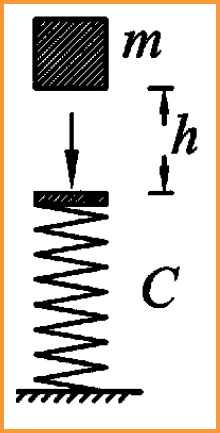
BAŽANT’S FIGURE 2(a)
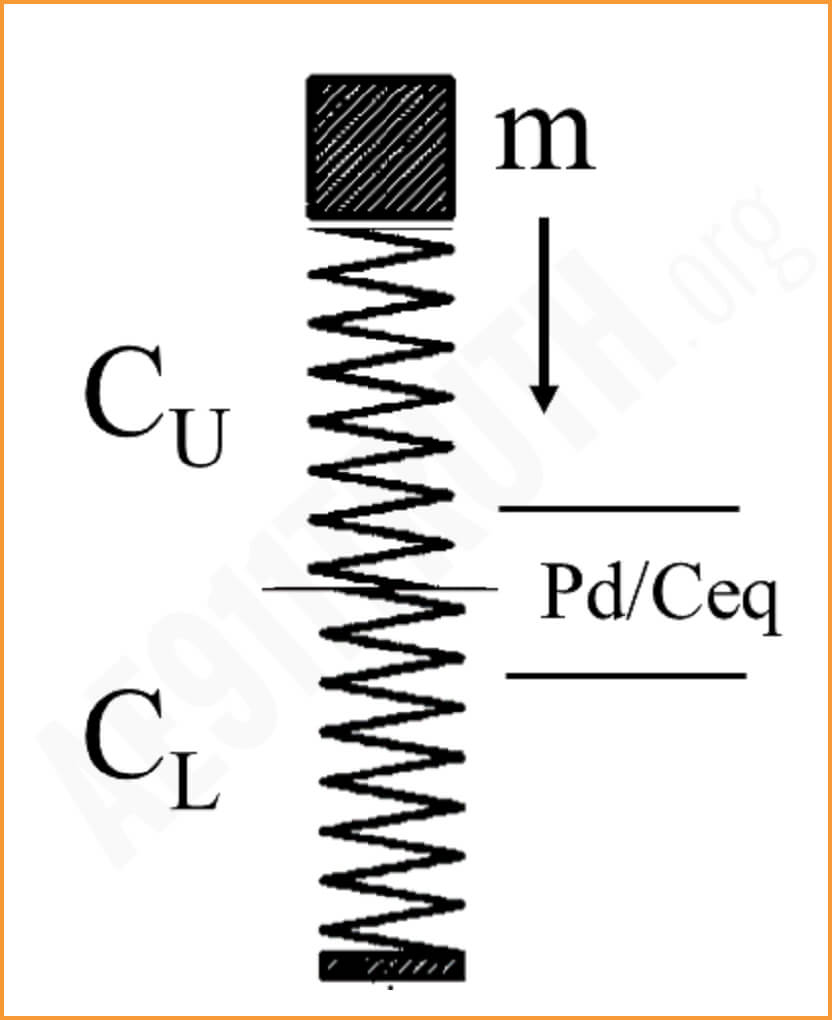
WHAT BAŽANT’S FIGURE 2(a) SHOULD HAVE BEEN
- As noted above, the elastic interaction of the two parts of the building could not involve the descent of the upper portion for a full story, h, of the building. The actual distance could only be the distance due to the compression of the two parts of the building, Pd/Ceq, calculated below, which only amounts to a small fraction of the distance of a full story that Bažant used.
Correcting these errors in Equation (1),
- The CDCU theory does not provide a load amplification factor of 31. It actually doesn’t even provide an overload, as the ratio is less than one, and is not large enough to overcome the design load capacity of the lower part of the building to resist collapse.
- Collapse would not be initiated and could not occur.
- Bažant’s theoretical proof that the elastic response of the lower part of the building cannot withstand the impact of the upper portion of the building is not valid.
- Bažant’s theory, when corrected, does not explain the destruction of the Twin Towers.
In conclusion, the NIST Report purporting to explain the complete collapse of the Twin Towers on 9/11 fails, since it relies on Bažant’s CDCU theory to accurately portray the event, and that theory has been shown to be invalid.
1.Mechanics of Progressive Collapse: Learning from World Trade Center and Building Demolitions, Zdeněk P. Bažant and Mathieu Verdure, Journal of Engineering Mechanics, March 2007; What Did and Did Not Cause Collapse of World Trade Center Twin Towers in New York?, Zdeněk P. Bažant, Jia-Liang Le, Frank R. Greening, and David B. Jenson, Journal of Engineering Mechanics, October 2008; Why the Observed Motion History of World Trade Center Towers is Smooth, Zdeněk P. Bažant and Jia-Liang Le, Journal of Engineering Mechanics, January 2011; Spontaneous Collapse Mechanism of World Trade Center Twin Towers and Progressive Collapse in General, Zdeněk P. Bažant and Jia-Liang Le, Journal of Structural Engineering, April 8, 2022.
2. NIST (National Institute of Standards and Technology). 2005. Federal Building and Fire Safety Investigation of the World Trade Center Disaster: Final Report on the Collapse of the World Trade Center Towers. NIST NCSTAR 1-6 Structural Fire Response and Probable Collapse Sequence of the World Trade Center Towers (authored by John L. Gross and Therese P. McAllister), paragraph 9.4.4, p. 323, wherein they explicitly state (referring to Bažant’s theory), “NIST agrees with the assessment of the tower’s required structural capacity to absorb the released energy of the upper building section as it began to fall as an approximate lower bound.”
3. The Missing Jolt, Szamboti & MacQueen, Journal of 9/11 Studies, January 2009, Appendix C.
4. The Missing Jolt, Szamboti & MacQueen, Journal of 9/11 Studies, January 2009, Appendix D.
5. Analysis of the Mass and Potential Energy of World Trade Center Tower 1, Gregory Urich, Journal of 9/11 Studies, December 2007.
6. Some Misunderstandings Related to WTC Collapse Analysis, Gregory Szuladzinski, Anthony Szamboti, Richard Johns, Journal of Protective Structures, June 2013.