Part 7: WTC 7 Fire and Column Failure
The Popular Mechanics chapter regarding the mysterious collapse of WTC 7 shows itself to be no more promising than its previous chapter on the Twin Towers.

The Popular Mechanics chapter regarding the mysterious collapse of WTC 7 shows itself to be no more promising than its previous chapter on the Twin Towers.
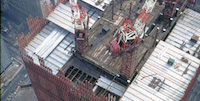
Abstract: This paper investigates the energy absorption potential offered by light weight concrete (LWC) floors, perhaps when a building is poised to collapse from some extreme loading event. It is assumed here that the failure of LWC structural floor slabs would likely result in both break-up…

WTC Building 7, also known as the Salomon Brothers Building or WTC 7, was a 47–story skyscraper that was part of the World Trade Center complex. Built in 1984, Building 7 would have been the tallest high–rise in thirty–three of our United States. Building 7…
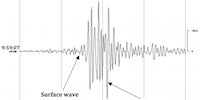
Abstract: The seismic signals propagating from New York on September 11, 2001, recorded at Palisades (34 km) and published by the Lamont-Doherty Earth Observatory of Columbia University (LDEO), have here been subjected to a new critical study concerning their sources. The aim of this paper is…
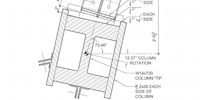
Introduction: The “Analysis of Structural Response of WTC 7 to Fire and Sequential Failures Leading to Collapse” (McAllister et al. 2012) published by the American Society of Civil Engineers (ASCE) presents a complex procedure used to analyze the structural behavior of Seven World Trade Center (WTC…
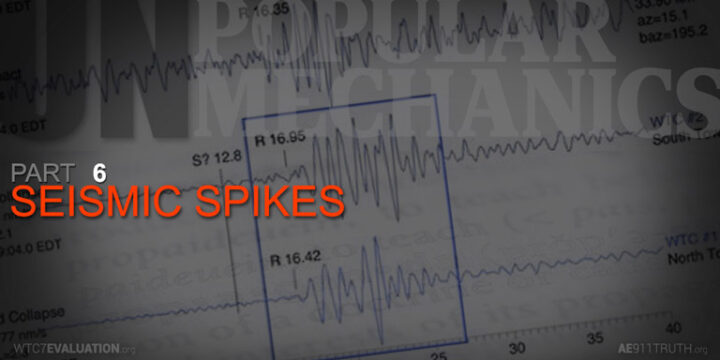
The final section of Popular Mechanics’ chapter on the Twin Towers addresses a theory that is not widely believed among members of the 9/11 Truth Movement: that large seismic spikes indicative of explosions occurred before the Towers collapsed.
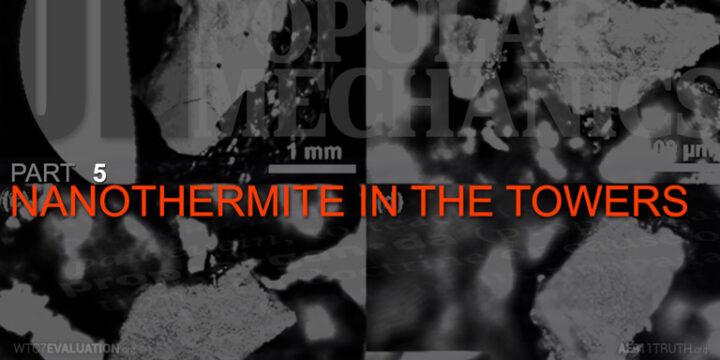
The next section of Popular Mechanics’ book deals with another subject not previously dealt with in the 2006 edition: the nanothermite discovered in dust samples from the World Trade Center
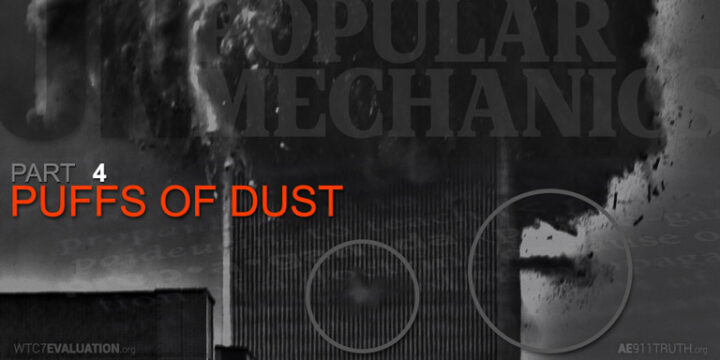
The next section of Popular Mechanics’ book deals with one of the more direct pieces of evidence of demolition for the Towers — the isolated ejections of dust and debris from the Towers during the collapses. Like most of its arguments, PM’s challenge to this evidence of demolition is extremely weak and was previously refuted by experts at AE911Truth and elsewhere.
In Popular Mechanics’ next section, they discuss the rate at which the Twin Towers were destroyed. It is quite evident that PM has again misrepresented the characteristics of the buildings’ destruction.
Popular Mechanics next turns to the issue of the plane impacts and fire damage and their roles in the WTC event.