
Editor’s Note: Frances Shure, M.A., L.P.C., has performed an in-depth analysis addressing a key issue of our time: “Why Do Good People Become Silent — or Worse — About 9/11?” The resulting essay, being presented here as a series, is a synthesis of both academic research and clinical observations.
In this installment, we continue Ms. Shure’s analysis with “Part 14: Learned Helplessness,” a conditioned response to trauma or adversity that involves ongoing pain as well as actual or perceived lack of control.
Please note that because Architects & Engineers for 9/11 Truth is dedicated to researching and disseminating scientific information about the destruction of three World Trade Center skyscrapers on September 11, 2001, and does not speculate as to the identity or motives of the perpetrators, any reference to names or motives of the attackers in this series of articles, made by either the author or the individuals she quotes, is a personal opinion and not the viewpoint of AE911Truth.
“I can see that 9/11 was a false flag operation, but there is nothing I can do to make a difference,” a male friend quietly admitted to me.
He is one of several friends who, in the years since September 11, 2001, have made similar remarks when I have asked them to tell me their thoughts about the evidence that refutes the official account of 9/11.
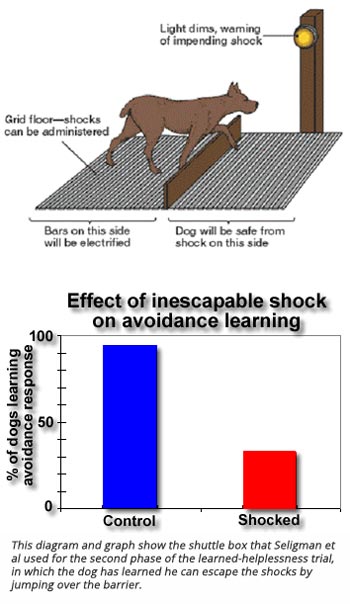 In the 1960s, Seligman et al subjected approximately 150 harnessed and restrained dogs to a series of 64 moderately painful and inescapable electric shocks on the first day of each trial. It didn’t take the dogs long during that first phase to “learn” that they could not escape the torture. Soon they gave up trying and passively submitted to the pain, whining and sometimes rolling over in a submissive posture.
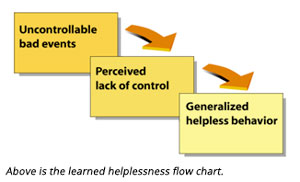 These discoveries have profound implications for child rearing. Infants, children, and adolescents who are subjected to uncontrollable trauma or adverse events have a poor self-image. They become hopeless, unmotivated, depressed or anxious, and they fail to learn. These children become the very adults who, when subjected to the evidence that refutes the official 9/11 storyline, might run in the other direction to avoid the messenger — or, if cornered or pressed, quietly admit, “There is nothing I can do to make a difference” (or a variation thereof).
Endnotes
1 Sauron is the main antagonist in J. R. R. Tolkien’s The Lord of the Rings. The cursed ring, which was to be destroyed by the relatively pure hero Frodo Baggins, seduced even the most pure of beings who possessed it into an insatiable lust for power. My acquaintance was implicating that if we were going to challenge such evil as was perpetrated on 9/11, then we had better have a ring of evil power in our possession.
2 After a conversation with one of my editors, I agreed with her that we should help raise consciousness about the plight of animals in our world. We have been trained in our culture to think of non-human beings as objects, even commodities — and as much less important than humans. The everyday language we use is one way to increase our awareness that animals feel, both physically and emotionally. They respond to pain, imprisonment, or betrayal with fear and anguish and confusion. They also respond to being treated with compassion, respect, and love. Thus, in this essay, I will use the pronoun “who” rather than “that” in referring to these innocents. To those who want to witness the profound sensitivity and intelligence of animals, I highly recommend one of the most beautiful films I have seen: The Animal Communicator, which may be watched or purchased online.
3 Martin E. P. Seligman, Helplessness: On Depression, Development, and Death (W.H. Freeman & Co., May 1992), 22 – 23.
4 Seligman, Helplessness.
5 Ibid. xx – xxiv.
6 Seligman, Helplessness
7 Ibid.60.
8 Stanislav Grof, Beyond the Brain: Birth, Death and Transcendence in Psychotherapy (State University of New York, 1985).
Stanislav Grof, The Adventure of Self-Discovery: Dimensions of Consciousness and New Perspectives in Psychotherapy and Inner Exploration (State University of New York Press, 1988).
Stanislav Grof is a world-renowned pioneer of psychodynamic and transpersonal psychology.
9 Dennis, Sheila, and Mathew Linn, Healing the Future. The Linns tell their personal stories of healing from societal trauma, activated by earlier developmental trauma, offering examples of simple healing exercises.
Note: Electronic sources in the endnotes have been archived. If they can no longer be found by a search on the Internet, readers desiring a copy may contact Frances Shure for a copy [ here ].